
The Science Behind Equine Facilitation
Connections
Equine Facilitation is grounded in well-established principles from psychology, neuroscience, and behavioral science.
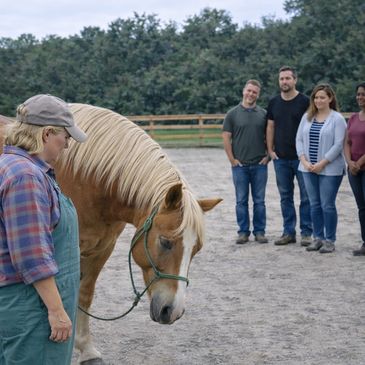
Horses are highly attuned, social animals that naturally respond to human body language, emotion, and energy. They rely on acute awareness of their environment for safety. This makes them exceptionally sensitive to subtle cues that humans often overlook.
Why Horses?
• Immediate Feedback
Horses respond in real time to nonverbal communication, providing honest, unbiased feedback without judgment.
• Emotional Regulation
Research shows that interacting with animals can help regulate the nervous system, reduce stress, and promote calm, focused states.
• Mirror Neurons & Awareness
Horses often reflect human
• Immediate Feedback
Horses respond in real time to nonverbal communication, providing honest, unbiased feedback without judgment.
• Emotional Regulation
Research shows that interacting with animals can help regulate the nervous system, reduce stress, and promote calm, focused states.
• Mirror Neurons & Awareness
Horses often reflect human emotional states, helping participants become more aware of their own behaviors and internal responses.
• Experiential Learning
Hands-on interaction leads to deeper learning and retention compared to traditional instruction.
Supported by Research
Supported by Research
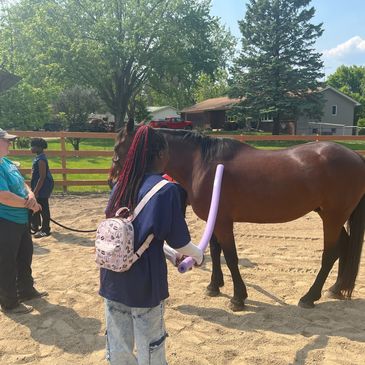
Equine-assisted programs have been studied across multiple fields including:
• Psychology & Mental Health
Improved emotional regulation, reduced anxiety, and increased self-awareness
• Education & Youth Development
Enhanced confidence, communication skills, and social engagement
• Leadership & Team Development
Improved trust, communication, and problem-solving in group settings
Why It Matters?
Supported by Research
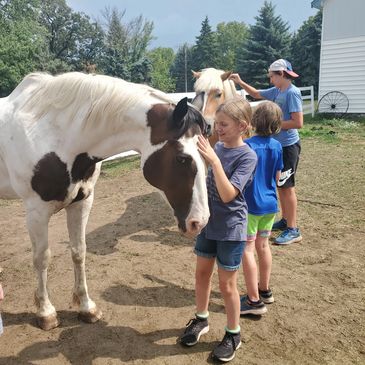
At WEE Farm, equine facilitation is not about riding or horsemanship.
It’s about creating meaningful, structured interactions that help individuals:
• Build confidence
• Develop emotional awareness
• Strengthen communication skills
• Experience connection in a safe, grounded environment
“Our approach integrates principles from trauma-info
At WEE Farm, equine facilitation is not about riding or horsemanship.
It’s about creating meaningful, structured interactions that help individuals:
• Build confidence
• Develop emotional awareness
• Strengthen communication skills
• Experience connection in a safe, grounded environment
“Our approach integrates principles from trauma-informed care, experiential learning theory, and human-animal interaction research to create impactful, evidence-informed experiences.”
-Dr. Bonnie Laabs